
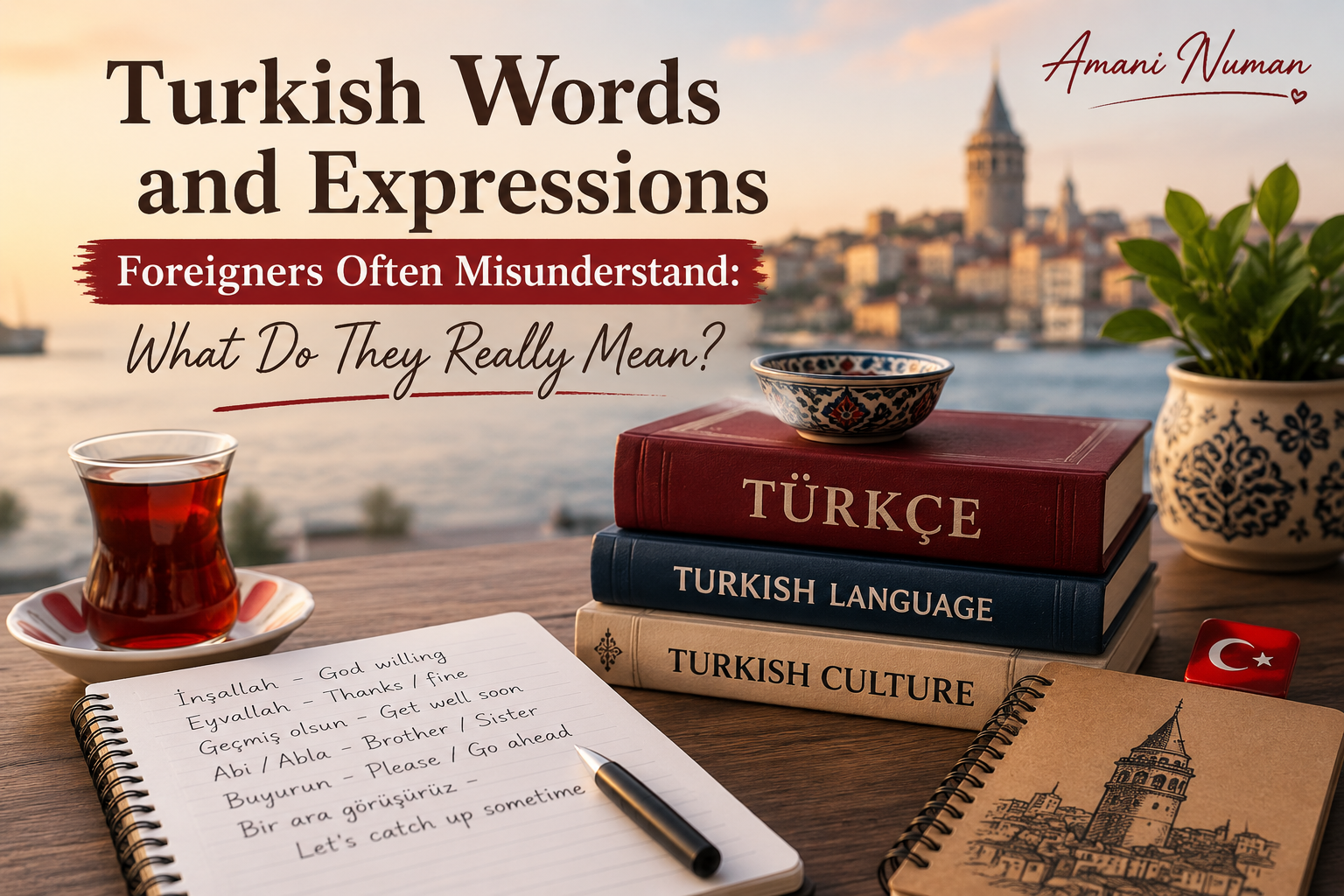
Turkish is not always as straightforward as it looks. You can learn thousands of Turkish words, memorize the grammar and still find yourself confused when you start communicating with Turkish people in everyday life. The reason is that many Turkish expressions cannot be understood simply by translating them word for word. Their meaning depends on the situation, the relationship between the speakers, their tone of voice and even the cultural context. A Turkish person may say “İnşallah” without making a clear promise, “Bir ara görüşürüz” without actually arranging a meeting, or “Helal olsun!” to express admiration, approval or appreciation rather than its literal meaning. Foreigners often try to translate these expressions literally and then wonder why Turkish people seem indirect, overly friendly or sometimes contradictory. In reality, these expressions are part of a communication system in which politeness, respect, warmth and social harmony are often more important than saying exactly what you mean in the most direct possible way. This is why learning Turkish is not only about vocabulary and grammar. To communicate naturally in Turkey, you also need to understand what people really mean when they use certain words and expressions.
One of the most interesting examples is “İnşallah.” Literally, it means “if God wills,” and it comes from Arabic in shā’a Allāh. However, in everyday Turkish, inşallah can have several different functions. Sometimes it expresses a sincere hope: “Yarın görüşürüz inşallah” — “Hopefully, we’ll see each other tomorrow.” Sometimes it means that the speaker genuinely intends to do something but does not want to make an absolute promise. And sometimes, depending on the context and tone, inşallah can be understood almost as a polite way of saying “we’ll see” or “hopefully, but I’m not promising.” Another expression that can confuse foreigners is “Geçmiş olsun.” Literally, it can be understood as something like “may it be past,” but Turkish people use it when someone is sick, injured, has had an accident, experienced a difficult situation or even had a problem such as a car breakdown. It is not simply “get well soon”; it is a culturally established expression of sympathy and goodwill. Then there is “Allah Allah!”, which can sound extremely religious to someone who has just learned Turkish. Of course, the expression contains the word Allah, but in everyday speech it can simply express surprise, disbelief, confusion or curiosity: “Allah Allah, nasıl oldu?” can be closer to “Really? How did that happen?” than to a religious statement. Similarly, “eyvallah” has a fascinating range of meanings. Depending on the situation, it can mean “thanks,” “okay,” “alright,” “got it,” “fair enough,” or even function as a casual way of ending a conversation. A foreigner who tries to assign one fixed English or Russian equivalent to eyvallah will quickly discover that the word refuses to stay in one box.
Another thing foreigners often misunderstand is the way Turkish people address other people. You may hear a man calling a complete stranger “abi”, literally “older brother,” or a woman calling another woman “abla”, literally “older sister.” This does not necessarily mean that they are related. These words can express friendliness, respect, familiarity or simply a culturally appropriate way of addressing someone slightly older. In shops, restaurants, taxis and everyday conversations, you can hear abi and abla constantly. There are also “amca” (uncle) and “teyze” (aunt), which can similarly be used for older people even when there is no family relationship. Another expression that surprises foreigners is “baş üstüne.” Literally, it means something like “on top of the head,” which sounds strange if translated word for word. In Turkish, however, baş üstüne is a respectful way of saying “certainly,” “of course,” or “consider it done.” The image behind the expression is one of accepting something with great respect, as if placing the request above one's head. “Buyurun” is another word that seems simple but is actually used in an enormous number of situations. You may hear it when someone invites you to enter, offers you something, asks you to speak, gives you permission to proceed, answers the telephone, welcomes you into a shop or hands you something. Depending on the situation, buyurun can be translated as “please,” “go ahead,” “here you are,” “come in,” or “how can I help you?” This is a perfect example of why Turkish cannot always be learned by memorizing one translation for each word.
Turkish communication also contains many expressions that are polite precisely because they are not completely direct. One of the most famous examples is “Bir ara görüşürüz.” Literally, it means “we’ll see each other sometime.” A foreigner may hear this and immediately think that a meeting is going to happen and wait for the other person to suggest a date. But depending on the relationship and context, “bir ara görüşürüz” can be a genuine suggestion or simply a friendly way to end a conversation without making concrete plans. Another interesting example is “Hakkını helal et,” which can be heard when saying goodbye and expresses a request for forgiveness or for the other person not to hold anything against you. And then there is “Helal olsun!” — an expression of admiration, approval or respect that has little to do with its literal meaning. For foreigners, both expressions can be confusing because the same word helal appears in very different communicative contexts. Understanding what Turkish people actually mean requires more than knowing the dictionary definition — you also need to understand the cultural context behind the expression. Turkish people also frequently soften refusals rather than saying a blunt “hayır.” Instead of directly saying “no,” someone might say “Bakarız” (“we’ll see”), “İnşallah”, “Şimdi biraz zor” (“it’s a little difficult right now”), or “Kısmet” (“if it’s meant to be / it’s up to fate”). To a foreigner, this can be confusing because these expressions may sound like an actual possibility. In some situations they are; in others, they are simply culturally softer ways of declining. The same applies to “tamam.” Although it usually means “okay,” its meaning can change dramatically with intonation. Tamam can mean genuine agreement, reluctant acceptance, “I understand,” “enough,” “stop arguing,” or even “fine, whatever.” A short, flat “Tamam.” in the middle of an argument is very different from a cheerful “Tamam, tamam!” between friends.
Finally, Turkish has many small linguistic details that communicate warmth and social closeness without being explicitly explained. One example is the suffix -cığım / -ciğim / -cuğum / -cüğüm, as in Ayşeciğim, Canım or other affectionate forms. Adding this type of ending can make a name sound warmer, more affectionate or more intimate, although the exact effect depends on the relationship and the speaker's tone. Turkish people also frequently use diminutives and affectionate forms when talking to children, friends, partners and sometimes even customers. Offering tea is another cultural habit that foreigners quickly notice. In Turkey, çay is not simply a drink; offering tea can be a way of welcoming someone, showing hospitality, continuing a conversation or creating a moment of social connection. Refusing tea does not necessarily offend anyone, but accepting it can sometimes communicate openness and friendliness. All these examples show why understanding Turkish requires more than translating Turkish words into another language. The real meaning often lives between the words. If you want to understand Turkish people naturally, pay attention not only to what they say, but also to when they say it, to whom, and with what tone. Once you start noticing these patterns, everyday conversations in Turkey become much easier — and much more interesting.
Want to Learn Turkish Beyond Grammar and Textbooks?
If you want to speak Turkish naturally and understand not only the words, but also the culture, expressions and communication habits behind the language, I can help you. In my Turkish lessons, we go beyond grammar and vocabulary. We explore real-life Turkish, cultural nuances, everyday expressions and situations that you may not find in a textbook. You will not only learn how to speak Turkish, but also understand how Turkish people actually communicate.
If you would like to immerse yourself in the Turkish language and culture and learn Turkish in a practical, natural way, feel free to contact me and start your Turkish lessons.
📱 +90 531 244 47 14
Amani Numan
Turkish Words and Expressions Foreigners Often Misunderstand: What Do They Really Mean?
 Anasayfaya Dön