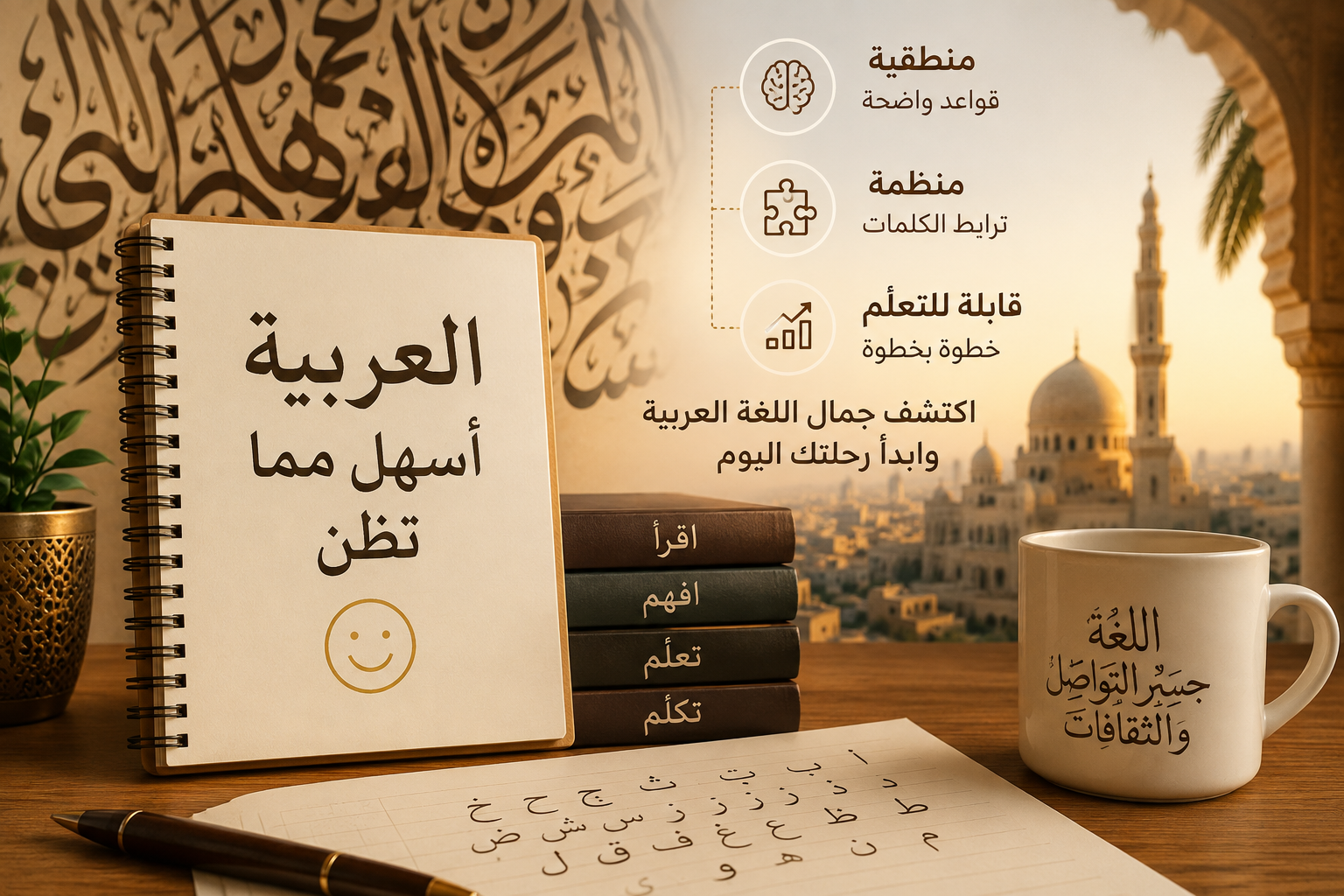
You have probably heard the phrase, "Arabic is a very difficult language." Because of this, many people assume that learning Arabic will be too challenging before they even begin their first lesson. However, there are several reasons why Arabic has this reputation. Its unique alphabet, right-to-left writing system, and numerous regional dialects often make the language seem more complicated than it actually is. Once you become familiar with Arabic, however, many of these misconceptions quickly disappear.
One of the first things that people find challenging is that Arabic is written from right to left. Since English speakers learn to read and write from left to right from childhood, this can feel unusual at first. A simple everyday example can help explain this. Imagine brushing your teeth with your right hand every day. If you suddenly switch to your left hand, the task feels awkward even though you are doing exactly the same thing. The movement simply requires your brain to adapt to a new pattern. Learning to read Arabic is very similar. Your eyes gradually learn to move from right to left instead of left to right. During the first few days it may feel slow, but with regular practice this becomes completely natural.
The Arabic alphabet is remarkable not only because of its writing direction but also because of its rich history and beauty. Developed from the Nabataean script, which originated from the Aramaic alphabet between the 3rd and 4th centuries AD, the Arabic alphabet has a history of approximately 1,700 years. It is one of the world's oldest writing systems still in use today. Arabic calligraphy, known as Islamic calligraphy, is considered one of the most beautiful forms of artistic writing. For centuries, Arabic script has decorated mosques, palaces, historical monuments, and priceless handwritten manuscripts. Many students discover that Arabic letters are not merely symbols used for writing, but also an important part of a rich artistic tradition.
Another reason people believe Arabic is difficult is its dialects. In reality, the standard form of the language is Modern Standard Arabic (MSA), also known as Fusha Arabic. It is used in books, newspapers, official documents, education, news broadcasts, and formal television programs throughout the Arab world. In everyday conversations, however, people speak regional dialects. These dialects vary from country to country and sometimes even from city to city. The pronunciation of certain words—and even some letters—may differ. For example, the same word may be pronounced differently in Yemen, Syria, Egypt, Iraq, or Morocco. Although this may seem confusing at first, most dialects share the same foundation. Once you have learned Modern Standard Arabic, understanding different dialects becomes much easier.
Interestingly, Arabic has also influenced the English language. Although English contains far fewer Arabic loanwords than Turkish, many common English words originally came from Arabic through Latin, Spanish, French, or Italian. Examples include algebra, algorithm, alcohol, coffee, cotton, sugar, magazine, admiral, orange, and safari. Recognizing these familiar words often makes students realize that Arabic has had a much greater influence on world languages than they previously imagined.
In my lessons, I do much more than help students memorize vocabulary. I teach the logic behind the Arabic language. The most effective way to learn any language is to understand how its system works rather than simply memorizing words and grammar rules. Once students understand this logic, they begin to recognize patterns, making it much easier to learn both Modern Standard Arabic and regional dialects. This is why many of my students quickly discover that Arabic is far more organized, logical, and approachable than they had expected.
In conclusion, Arabic is not as difficult as many people believe. With the right learning method, consistent practice, and proper guidance, it becomes an enjoyable and rewarding language to learn. The hardest part is often taking the first step. Once you begin, you will discover the beauty, logic, and richness of one of the world's oldest and most fascinating languages.
If you have any questions or would like to begin your Arabic learning journey, feel free to contact me.
📱 +90 531 244 47 14
Amani Numan
Take the first step toward your new future today with confidence!